Sunday, March 18, 2018

5 Reasons You Should Use Scrivener to Write Your Novel

Wow. I have not written a blog post in almost two years. Sorry about that. Life has been very interesting. Hopefully, I'll get back into a rhythm soon. In the meantime, here's a post that I wrote last year but never got around to polishing up until today. Hope someone out there is still listening.
Image result for scrivener logo
Pen or pencil? Spiral notebook or binder? Every writer has  his or her own preferences. And these days, there's another choice writers need to make. Should we use Microsoft Word or one of the independent programs designed specifically for fiction writers? 
My program of choice is Scrivener, and today I'm going to tell you why it should be yours too. Just so we're clear, the creators of Scrivener are not paying me to do this. I really love the program that much. Here are five reasons why it's the perfect tool for a busy writer. 

1) You can keep everything in one place.

 Related image

Microsoft Word has its uses, but it really wasn't designed for writing a novel. You can only open one document at a time. If you want to flip back to your research or your character sketches to make sure you don't give someone the wrong eye color, you'd have to open that in a different window. Not in Scrivener. 
Scrivener doesn't save documents. It saves projects. There are three basic pieces of each project. There's the binder, the editor, and the inspector. The binder holds all the documents related to that project. Research, brainstorming, notes, manuscript, all in one place. To see any particular page, you just click on it in the binder and it will open in the editor. At the same time the inspector will display a notecard in which you can type a brief summary of that document.  If you want to look at more than one page at the same time, you can split the editor in two either horizontally or vertically. The editor can also be converted into a corkboard where all your notecards are displayed side by side. This is a great way to plot your story. 

2) You can write scenes instead of chapters. 

In the binder, you can create folders and sub-folders. As many as you want. I like to make each chapter a folder, and then I put each scene in its own document. I usually don't write my stories in chronological order, so this allows me to keep the pieces together while I'm filling in the gaps. Unlike the Windows file explorer, which always stores documents in alphabetical order, Scrivener allows you to drag the pieces of your project to whichever spot in the folder makes the most sense to you. Great for us non-linear thinkers.    

3) You can color code. 

Related image
You can label each document with a color corresponding to any system you want. This color can represent whether the scene is a first draft or pretty much perfect already, it can represent which character's point of view the scene is told from, or anything else you need to know. This color will appear as a stripe across the document in the binder and/or a thumbtack in the notecard. 

4) You can create hyperlinks between documents. 

When I'm reading through my notes, I sometimes come across a name of a character or a place, and I can't remember for the life of me who or what that was supposed to be. Does that happen to you? Well, Scrivener can help you remember. When you're first typing up the notes, just highlight the name and create a Scrivener link to that character's profile or the chapter of the story where you mentioned that place. Then, you can just click on the name and there's everything you need to know. You can even set it to open the link in a second editor so you don't lose your place. 


5) You can make the document full screen. 

Do you ever wish you could just make all those pesky buttons and drop down menus disappear so you can be alone with your story? Scrivener can do that. With a single click, the document becomes the entire screen, just you and your words. Need to switch back to editing mode? Just press escape. 

Those are just a few of the reasons that Scrivener is awesome. I could rhapsodize about it all day, but I'd rather go work on my novel. Just one more tip before I go. 
The program looks dauntingly complicated at first. It has almost as many buttons as the cockpit of a jet plane. So if you're a first time scrivener, DO THE TUTORIAL. It takes about two hours, and it's dead boring, but you will get more out of the program if you actually know how to use it.    
Happy scrivening! (Yes, of course that's a word. Don't give me that look.)


Monday, September 5, 2016

5 Tips For Writing Israeli Characters


First off, I want to make it very clear that this is not a political post. I am not interested in arguing about Israel's right to exist. If that's what you're looking for, go look somewhere else. This post is directed at fiction writers who want to put Israeli characters in their stories. Any political comments will be deleted. Got it? Good. Moving on. 
As you might have figured out from my name, I am Israeli born and bred. Israelis are some of the most creative people in the world. Did you know that we invented the cell phone, the flash drive, and the cherry tomato? Talk about shaping the future. I mean, can you imagine life without cherry tomatoes?
So why not liven up your next novel or short story with one or more of us awesome Israelis? Since you're probably a starving artist who can't afford to fly around the world just for a little research, here are five basic tips to get you started. 

1) Not all Israelis are Jewish.

Israel is known as the Jewish State, and there are a lot of misconceptions about what this means. It's true that the majority of the population, (about 80%), identify themselves as Jews. However, there is freedom of religion and separation of church and state, or synagogue and state in this case. Israel is home to plenty of Muslims, Christians, Buddhists, and even a few adherents of the Church of the Flying Spaghetti Monster, all of whom are free to practice their beliefs as long as those beliefs don't harm anyone else. Even among Jewish Israelis, there's a very broad spectrum of lifestyles. Completely secular, traditional, religious with more modern leanings, Hasidim? Take your pick.

2) Not all Israelis are soldiers. 

Israel has a permanent draft, which means that theoretically every Israeli citizen serves in the military for at least two years when they reach the age of eighteen. In practice, it's a lot more complicated than that. There are exemptions. There are all sorts of non-combat positions within the military. Then there's something called Sheirut Le'umi, which is basically volunteer work that counts as military service even though you never wear a uniform or set foot in a training camp. Basically, you only become an actual soldier if you want to. So before you stick military service into your character's backstory, consider whether it really fits his or her personality. Don't put it in there just to make the character more authentically Israeli.

3) Not all Israeli soldiers are Jason Bourne.

Even if your Israeli character is a veteran, even if he or she served in a combat unit - (Israel does have female combat units, and the world's only co-ed combat unit) - this doesn't automatically mean that he or she is trained in three forms of martial arts, able to shoot down a moving target from the next continent over, and possibly even build a bomb out of chewing gum and a hairpin. This is a stereotype I see a lot in American television. In fact, it's a stereotype I've seen in military characters of every nationality. The truth is that unless your character is career military, they'll do basic training and they'll get the rest of their skills the hard way. Their fighting style will be quick, dirty, and practical. And if they're outnumbered, they'll just give the enemy a good running away from.   

4) All Israelis Are as Stubborn as the Proverbial Mule.

This is one stereotype that is absolutely rooted in fact. We are stubborn. We never ever give up on the things we believe in.

5) Our Nationality Is Not the Most Interesting Thing About Us.

Again, this is a problem I've seen with characters of every race and culture. In their eagerness to write ethnically diverse stories, many writers forget to give their characters actual personalities. A person's culture is part of their personality, but it isn't the biggest part. Don't just stick the label Israeli on a character and think that says it all. Tell me what kind of home he grew up in, how many siblings she has, and what he thought he would be when he grew up. Did she get into trouble when she was a teenager? What's the worst mistake he ever made? 

Happy Writing!

Sunday, June 5, 2016

The Fantastic Five Dialogue Tag

Yay! My first blog tag! (Happy dance.) This tag was created by the amazing Nate Philbrick of "You Write Fiction" and passed onto me by the equally amazing Hannah Heath. It is exactly what the title says. You share five pieces of dialogue from your latest work in progress, and then tag five other bloggers to do the same. 
So before I could get started I had to pick a work in progress. That's right. I have more than one. I know, I know. It's a terrible habit. I can't help it. If story ideas were lightning, I would be...a lightning rod, I guess.That sounded a lot wittier in my head. Anyway, I have three partially written stories to choose from at the moment, and by a careful, rational process of elimination, taking into account... Oh, who am I kidding? I did eenie-meenie-mynie-moe. And I picked my oldest work in progress, a novel I've been writing on and off for about two years. 
My working title is "Little Sister". It falls broadly in the YA dystopia genre, and the main character is a female soldier who is struggling to compete with men and earn their respect while still maintaining her femininity, a dilemma which I have personal experience with and which is severely underrepresented in fiction. 
So without further ado, here are five of my favorite pieces of dialogue in the story so far. I'm not sure they'll all make the final cut, so I'm glad I have this opportunity to share them with you anyway. 

"God, grant me patience. Or duct tape. Whichever is handy right now."

"You don't know what creative cursing is until you've been cursed at by a drill sergeant who's fluent in four languages and hasn't had real coffee in six months." 

"You listen hard, kid. Listen to everything, especially the things they don't say. Just because a lot of stupid people are willing to die for a cause, don't assume that cause is moral. Don't let the cheering crowds drown out the screams. Listen hard, and make sure you know exactly what you're fighting for." 

 "A small fire. I said a small fire."
"They're distracted, aren't they? God, girls are so picky." 

"I've lived my whole life in a war zone. You never get used to it. You think you have. You think you've seen the worst, and nothing can hurt that bad ever again. But then you fall in love, or you have a baby, and all of a sudden you have so much more to lose."

And that's all she wrote. For now. I hope to finish the first draft in another six months, and then it's editing time. I hope you're all going, "Ooh, I want to read that book." 
And now to pass on the blogging joy. I choose... (Turns in a circle with her eyes shut.)

Tyler Miller (The Black Cat Moan)

She's Novel

Kaitlin Hillerich (Ink and Quills)

K. M. Weiland (Helping Writers Become Authors)

Lily Schreiber (Fairy Tales of an Author)

Just click on their names to see their blogs. They are all really cool people and awesome writers. And if you don't have a blog, feel free to share some snippets of dialogue from your stories in the comments section below. It would make my day. 
See you again real soon. 

Friday, May 13, 2016

10 Things I Learned From Cordelia Chase

This might be the first in a series of posts about life lessons I learned from fictional characters. It also might be a random idea produced by my state of extreme sleep deprivation. It might even be both. 

Out of all the characters in all the books I've read and all the movies and TV shows I've watched, my favorite is Cordelia Chase. There is absolutely no contest. 
First introduced as a minor antagonist/comic relief in the first season of "Buffy the Vampire Slayer", Cordy slowly matured, becoming first a valuable ally to Buffy and the Scoobies, and later a hero in her own right. After high school graduation, (celebrated Sunnydale style with a giant snake demon eating the principal and burning the school to the ground,) she moved to Los Angeles to become an actress. Her rise to stardom was impeded by her total inability to act, but she did get a job as a secretary and demon hunter at Angel Investigations, a detective agency run by another Sunnydale expatriate, the vampire Angel. Over the course of the next five years, she became psychic, got transported to an alternate dimension where a cult of demon priests first made her their queen and then tried to kill her, ascended to a higher plane of existence where she was bored out of her mind, and saved the world several times over. If there was an award for the fictional character who has led the most eventful life, Cordelia would definitely be a strong contender.  
Here are ten important life lessons I learned from Cordelia Chase.  

1) Don't be afraid to ask questions. 
  Image result for cordelia chase quotes Image result for cordelia chase quotes

2) Always find out if the world is going to end before you bother to do your homework. 

3) Don't take crap from anyone. Especially ghosts. 
 

4) If a bunch of demon priests make you their queen, it probably won't end well, but enjoy it while it lasts. 

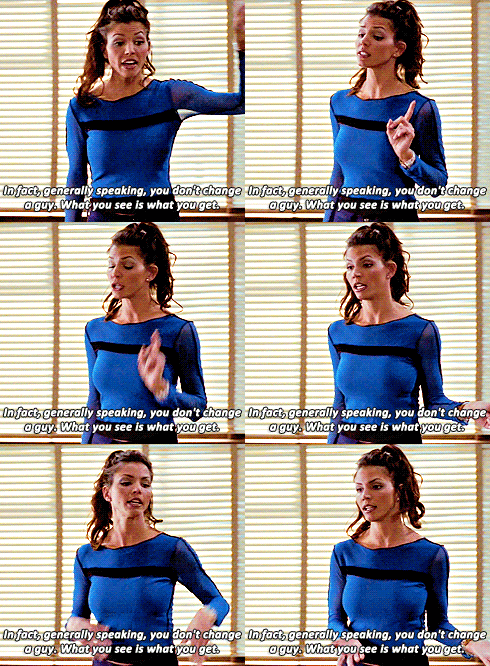
5) Never expect a man to change. 
 

6) Pay attention to your surroundings. 
 

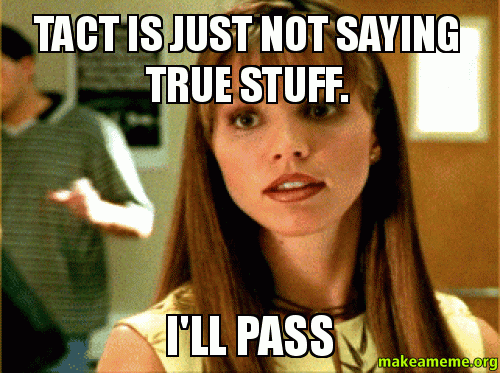
7) Tact is overrated. 

8) Know the difference between a superiority complex and a crossbow.

9) Admit when you're wrong. 


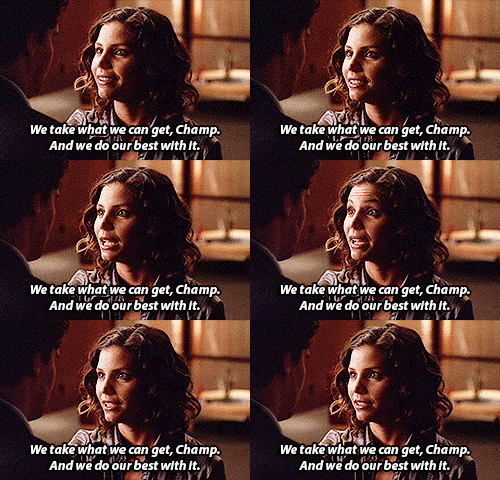
10) Do your best with what you've got. 
 

Tuesday, April 19, 2016

Keeping It Real: How to Make Your Reader Forget It's Just a Story

You know the feeling. You sat down to read just one chapter of that book, and when you looked up hours later...


That's what we want from all our books. We want them to overwhelm our minds, to become more real than reality, at least for a little while. And as writers, that's the kind of story we want to give people, but where to begin? How do you make sure that your story will cast its spell over the reader and not let go? 

1) Check Your Grammar and Spelling

"What?" you say. "I thought you were going to teach me magic. You want me to proofread?" Darn right, I want you to proofread. Nothing bursts that magic story bubble like bad grammar. Most people read in their first language, a language they learned from infancy. The rules of that language are ingrained in their subconscious, and as long as the words on the page obey those rules, they don't have to devote much attention to the actual reading. That leaves their brain free to visualize your story, to experience it rather than just reading it. But if the words are wrong, if they don't slide smoothly into the subconscious, then POP! The reader finds himself staring at a piece of paper covered with little black symbols while he tries to figure out what you actually meant to say. If this happens too often, he'll probably give up on your story and go read something better. If grammar isn't your strong point, you can always get someone to edit for you, but DON'T rely on a computer. Computers are wonderful tools, but even the smart ones are stupid. They don't know what you meant to say. They don't know which of the spelling variations carries the right connotation for this context. Their first language is binary. 
Obviously, if your story is being translated into a language you don't speak, grammar is no longer your responsibility. Just make sure to hire a good translator. 

2) Watch Out For the Melodrama!!!!

Okay, now that the boring part is out of the way, let's take a look at the emotions. I'll assume your characters have them. Emotions are what drive a story. They motivate the characters to take action. If someone betrays the hero's confidence, he will feel angry. This may cause him to cut the betrayer out of his life, or he might spill one of the betrayer's own secrets to get revenge. Either option might make a good story, but make sure that the reaction fits both the character's personality and the bigger picture. A normally easygoing guy isn't going to throw his friend off a bridge because she dented his car. If he does, the reader will find it difficult to maintain their suspension of disbelief. Be patient. Let the plot move at its natural pace. If that pace is too slow, then rethink the plot, but make sure that the motivations behind each character's actions are plausible. One weak link in the chain of causes and effects can destroy the whole story. 
  

3) Don't Touch the Fourth Wall

I'm not talking about a first person narrator who acts as if the reader is just another unlucky soul caught up in the zombie apocalypse or the alien invasion or whatever. I'm talking about an invisible narrator (in other words, the voice of the author) who interjects reminders that this is just a story they are making up for your entertainment. This was very common in children's books in the nineteenth and early twentieth centuries. I think of it as a nod and a wink to the grownup in the room. It's annoying and condescending. Let your reader remain cocooned in the warm embrace of your story and forget about reality for a while. 

Did I miss anything? What helps you get lost in a story? 

Sunday, April 3, 2016

14 Quotes That Only Writers Will Understand

Being a writer is kind of like being a soldier, or being married. (Speaking as someone who's done all three.) It's very hard, very rewarding, and no one who hasn't done it is ever going to understand. 
So when you've been asked for the thousandth time what your novel is about and when it's going to be published, and when you've resisted for the thousandth time the impulse to shake the questioner and scream, "What's with the third degree?!", it's good to know that you're not alone in the universe. Here are 14 quotes from great writers through the ages that perfectly sum up the joys and pains of our profession.     

1) William Shakespeare, "A Midsummer Night's Dream": “And as imagination bodies forth/ The forms of things unknown, the poet’s pen/ Turns them to shapes and gives to airy nothing/ A local habitation and a name.”


2) Samuel Johnson, "A Dictionary of the English Language": “It is the fate of those who toil at the lower employments of life to be rather driven by the fear of evil than attracted by the prospect of good…Among these unhappy mortals is the writer of dictionaries whom mankind have considered not as the pupil, but the slave of science…doomed only to remove rubbish and clear obstruction from the path of Learning and Genius who press forward to conquest and glory without bestowing a smile on the humble drudge that facilitates their progress. Every other author may aspire to praise; the lexicographer can only hope to escape reproach, and even this negative recompense has been yet granted to very few.”


3) William Blake: “Poetry fettered, fetters the human race.”


4) Lewis Carroll, "Through the Looking Glass": “When I use a word,” Humpty Dumpty said, in a rather scornful tone, “it means just what I choose it to mean – neither more nor less.” “The question is,” said Alice, “whether you can make words mean so many different things.” “The question is,” said Humpty Dumpty, “which is to be master – that’s all.”  


 5) Mark Twain, "The Adventures of Huckleberry Finn": “Persons attempting to find a motive in this narrative will be prosecuted. Persons attempting to find a moral in it will be banished. Persons attempting to find a plot in it will be shot. By order of the author.”

6) J.R.R. Tolkien, "The Hobbit": “Now it is a strange thing, but things that are good to have and days that are good to spend are soon told about and not much to listen to; while things that are uncomfortable, palpitating, and even gruesome, may make a good tale, and take a deal of telling anyway.”

7) Orson Welles: “If you want a happy ending, it depends on where you stop the story.”


8) Paul Theroux: “Fiction gives us the second chance that life denies us.”


9) Ron Carlson: “I always write from my own experiences whether I’ve had them or not.”


10) Peter S. Beagle, "Oakland Dragon Blues": “…That wasn’t a real story. It’s not in any book – you were just…making it up as you went along. I’ll bet you couldn’t repeat it right now if you tried. Like a little kid telling a lie.” The author laughed outright… “You’re quite right. We’re all little kids telling lies, writers are, hoping we can keep the lies straight and get away with them…Absolutely right…But you make the same mistake most people do. The magic’s not in books, not in the publishing – it’s in the telling, always.”


11) Terry Pratchett, "Wyrd Sisters": “Particles of raw inspiration sleet through the universe all the time. Every once in a while one of them hits a receptive mind which then invents DNA, or the flute sonata form, or a way of making light bulbs wear out in half the time. But most of them miss. Most people go through their whole lives without being hit by even one. Some people are even more unfortunate. They get them all.”


12) Stephen King, "On Writing": “It starts with this. Put your desk in the corner, and every time you sit down there to write, remind yourself why it isn’t in the center of the room. Art is a support system for life, not the other way around.”


13) J.K. Rowling, "Harry Potter and the Deathly Hallows": “Tell me one thing,” said Harry. “Is this real? Or has it been happening inside my head?”
“Of course it is happening inside your head, Harry. But why on earth should that mean it isn’t real?”


14) Erin Morgenstern, "The Night Circus": “It is important . . . Someone needs to tell those tales. When the battles are fought and won and lost, when the pirates find their treasures and the dragons eat their foes for breakfast . . . someone needs to tell their bits of overlapping narrative. There’s magic in that. It’s in the listener, and for each and every ear it will be different, and it will affect them in ways they can never predict. From the mundane to the profound. You may tell a tale that takes up residence in someone’s soul, becomes their blood and self and purpose. That tale will move them and drive them and who knows what they might do because of it, because of your words. That is your role, your gift. Your sister may be able to see the future, but you can shape it, boy. Do not forget that . . . There are many kinds of magic, after all.”

Did I miss any of your favorite writing quotes? Let me know down in the comments.  


Sunday, March 27, 2016

The Dos and Don'ts of Writing Characters With Special Powers


This is a guest post from the incredible Hannah Heath. She is an amazing writer and an all around cool person, but don't take my word for it. If you like this article, and I know you will, check out her blog here, and buy her e-book, "Skies of Dripping Gold", on Amazon.  


Hi everyone! I’m very excited to be able to contribute to Tamara’s blog today. Many thanks to Tamara for inviting me to do this, and many thanks to you for tuning in!
Raise your hand if you’ve ever wished you could use the Force…maybe to grab that book from your shelf without getting out of bed. Don’t lie. I know you have.
We’ve all been there. When we were little, we pretended to shoot fire from our hands or fly around the world, mimicking our favorite characters. 
Now we’re older and it’s less socially acceptable to pretend that empty paper towel rolls are magical swords. Lame, right? 
Thankfully for us writers, it’s totally normal to sit around and imagine up entirely new powers and magic systems. Suddenly things aren’t so drab.
But hold on a second. It’s easy to let superpowers and wizardry get out of control. I think a lot of authors get carried away by the sheer awesomeness of it, which is why books are overrun with characters wielding half-baked powers and living in magic systems that don’t make any sense. Authors get halfway into a story and end up so muddled with their power-building that they can’t dig themselves out.
You don’t want that to happen to you. Here are some do’s and don’ts to crafting characters who have special powers:


1) Don’t change rules just to make your character cooler. Do keep the rules consistent. 

Before you get in too deep, consider sitting down and outlining the rules and regulations of the special powers in your story. What are the powers? Where do they come from? How are they controlled? Are there other characters besides the main character that have powers? What are the limits to these powers? Think out all of the details, write them down somewhere, and stick with them. These rules should not be thrown out the window when it comes to your main character. If your character is somehow excluded from certain rules, you’ll want to add some other “special” rules to keep him in check. You’ll also need a good reason for your character’s specialness. Unless it’s a central part of the story, throwing a 1,000 year prophesy at her isn’t going to cut it. And no, the “I just want him to be awesomer than everyone else” reason is not a good reason. Sorry.

2) Don’t overlook complications. Do think the powers through first. 

Like the rules, your powers need to be considered extensively. Your character can draw energy from her surroundings? Great, but “energy” tends to be in the form of heat, so wouldn’t that mean she would cause everything around her to become extremely cold? She could kill herself and those around her. Your guy can fly? Epic. But can he breathe at high altitudes? What if he goes too high and passes out? Being able to read thoughts or see into the future is neat, but it also has the potential to unhinge a person’s mind. THINK about powers and all of their complications before you put them to work. There should be no silly wand-waving or foolish incantations in your story.

3) Don’t make your character all-powerful. Do give him restrictions. 

Meet Bob. Bob has unlimited resources, is the coolest person ever, and never comes up against anything he cannot conquer. Bob can do everything. Nobody likes Bob. Don’t write a Bob. No one wants to read about a character who is invincible, because then there’s never any suspense. We know he’s going to come out okay, so why even bother finishing the story? Give your character limits. You can either give them a character flaw (such as arrogance) or a “power check” (a rule that blocks the character from full use of their power). Or you really can have the character be all-powerful, but still unable to reach his/her goal. Anakin was the most powerful Force user in the galaxy. Padme was not, and the fact that he might not always be able to protect her literally drove him mad. Neo had unlimited power in the Matrix, but he was held back by the fact that he couldn’t save Trinity. While these are not restrictions of power, they are emotional restrictions that kept the characters in check.

4) Don’t be generic. Do dive into some research. 

There are a ton of special powers you can choose from. Mimicry, alchemy, quantum tunneling, psychometry, negation. There are a lot of cool ones. Just go ask Google for a list of supernatural powers and magical abilities. You as the writer can pick between many phenomenal cosmic powers! Why limit your characters to an itty bitty selection of abilities?

5) Don’t substitute powers for personality. Do make your character’s ability purposeful. 

Your character is a person first, then a power-user. Avoid getting so caught up in a character’s power that you forget to give the character any meaning outside of his power. Find a way to make your character’s ability entwined with the character’s personality and journey. When you give a character a power, ask yourself why. Why this power? Does it symbolize something? Does it move something along in a story? Or is it just random fluff that looks cool but serves no real purpose? I mean, we can’t all make our super cute vampire guys sparkle in the sunlight for no reason. Resist the urge. It’s hard, but I know you can do it.

6) Don’t just show the power. Do explain how the power feels. 

One of the most interesting parts of a character with special abilities is getting to understand what it feels like to wield those abilities. Does it feel like the unleashing of a dam? Or maybe the weaving together of threads? Is the feeling always there, or does it only show itself when the power is tapped into? Does using the ability make her feel tired, high, or frightened? Tell us what the character experiences when engaging her powers. It makes it more real.

Creating a character who has superpowers or magical abilities is insanely fun, so run wild. But not too wild. You are the creator of this character, so learn how to enjoy the creation process while also putting together a character with abilities that make sense and fit the story.
Now go forth and create awesome characters with awesome powers! Don’t be afraid to dream a little bigger.
Have you ever written a character with special powers? Do you have any tips to add or questions to ask? Leave a comment below!